Side-Channel-Secure Post-Quantum Cryptography
Classical Security
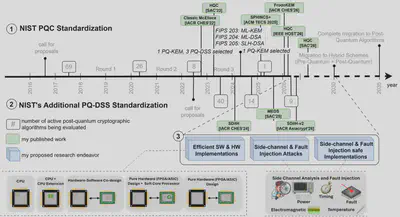
NIST has proposed retiring today’s public-key algorithms by 2030, and post-quantum schemes are already being deployed. Yet most hardware designs for them optimize speed first and add protection later, if at all.
I have built efficient hardware implementations of six PQC schemes from four mathematical families, many of them during NIST’s evaluation, and released them openly. NIST’s report explaining its selection of HQC for standardization (NIST IR 8545) cites my HQC hardware design. Building and evaluating these designs taught me that speed is not enough: an implementation must also withstand side-channel and fault-injection attacks before it is deployed.
Our recent power side-channel attack on a hardware implementation of HQC showed why: a design whose running time is independent of its secrets still leaked its key through power.
Roadmap
- Short term: Evaluate side-channel and fault-injection leakage of standardized PQC schemes across platforms, from microcontrollers to FPGAs and dedicated accelerators.
- Medium term: Design protected versions of the building blocks many schemes share, such as pseudorandom number generators, so that one secured module strengthens every scheme that uses it, and release them as an open-source library of protected PQC modules.
- Long term: An evaluation methodology that can inform future standards and schemes.
Connections
This direction shares lattice arithmetic and hardware-design techniques with Hardware for AI and AI for Hardware, and its side-channel methods carry over to Securing Fault-Tolerant Quantum Computers.

Sanjay Deshpande, Ph.D.
Postdoctoral Scholar
My research interests include Hardware Design, Cryptography, Post-Quantum Cryptography and Quantum Computer Security.