Securing Fault-Tolerant Quantum Computers from the Design Stage
Quantum Computer Cybersecurity
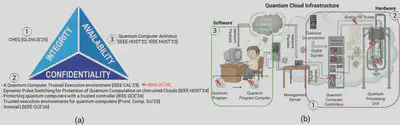
The field is moving from today’s noisy intermediate-scale quantum (NISQ) machines toward fault-tolerant quantum computers (FTQC), which will continuously correct their own errors; industry roadmaps target the first such machines within this decade.
Error correction depends on real-time decoders running on classical hardware such as FPGAs, the same kind of hardware I have spent years building and attacking. Decoder activity, the order in which encoded qubits are accessed, and the routing of logical operations will all leave observable traces that can reveal what is being computed.
Roadmap
- Short term: A threat model for FTQCs; measuring the power and timing leakage of FPGA decoders.
- Medium term: Fault injection against decoders; how code choice, chip layout, and compilation shape leakage.
- Long term: Secure-by-design fault-tolerant quantum computer architectures.
Connections
This direction builds on the controller hardware of Trustworthy Telemetry for Quantum Computers and Networks and the side-channel methods of Side-Channel-Secure Post-Quantum Cryptography.
Sanjay Deshpande, Ph.D.
Postdoctoral Scholar
My research interests include Hardware Design, Cryptography, Post-Quantum Cryptography and Quantum Computer Security.